When the Invisible Enemy Jumps from Animals to Humans: World Zoonoses Day and Our Health Risks

By S M Mehedi Hasan
“As humans continue to encroach upon wildlife habitats, wild pathogens are also finding a new refuge in the human body. This silent invasion is giving rise to one global pandemic after another.”
Even in the 21st century, an era of remarkable advances in modern medicine, the greatest threat to humanity is neither war nor natural disasters. Instead, it is the invisible microorganisms that cannot be seen with the naked eye. In recent years, infectious diseases such as COVID-19, Nipah virus, avian influenza (bird flu), and mpox (formerly monkeypox) have repeatedly reminded the world that human health is not confined to humans alone. As interactions among humans, domestic animals, wildlife, and the environment become increasingly complex, so does the risk of diseases crossing from animals to humans.
In scientific terms, these animal-borne diseases are known as zoonotic diseases, or simply zoonoses. According to the World Health Organization (WHO) and the U.S. Centers for Disease Control and Prevention (CDC), more than 200 diseases and infections have been identified as zoonotic. Even more concerning is the fact that nearly six out of every ten newly emerging infectious diseases in humans originate from animals, while approximately 75 percent of emerging infectious diseases have their source in wildlife.
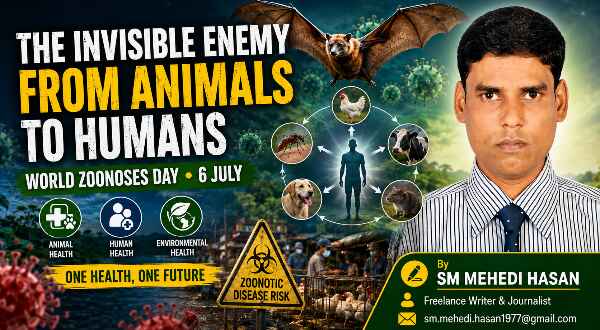
Today, July 6, marks the observance of World Zoonoses Day. More than just a commemorative occasion, the day serves as an important reminder that the health of humans, animals, and the environment is deeply interconnected, a reality highlighted by recent global outbreaks.
In July 1885, a nine-year-old French boy named Joseph Meister was severely bitten by a rabid dog. At that time, rabies was almost invariably fatal.
After years of research, scientist Louis Pasteur administered an experimental rabies vaccine to the child on July 6, 1885. Remarkably, Joseph survived and recovered completely. This historic breakthrough proved for the first time that a deadly disease transmitted from animals to humans could be prevented through vaccination.
To commemorate this milestone in medical history, World Zoonoses Day is observed every year on July 6.
According to the World Health Organization, zoonoses are infectious diseases that naturally spread from animals to humans. They may be caused by viruses, bacteria, fungi, parasites, or other infectious agents.
Direct Contact: Through contact with the blood, saliva, urine, feces, or other bodily fluids of infected animals.
Indirect Contact: Through contaminated environments such as animal shelters, cages, farms, or contaminated objects.
Foodborne Transmission: By consuming raw or undercooked meat, contaminated milk, eggs, or food contaminated by bats.
Vector-Borne Transmission: Through mosquitoes, ticks, flies, or other disease-carrying insects.
Rapid deforestation and urban expansion are shrinking wildlife habitats worldwide. As a result, humans and wild animals come into closer contact, creating opportunities for new pathogens to infect people.
Changes in temperature and rainfall patterns are expanding the habitats of disease-carrying insects. Diseases once confined to specific regions are now spreading into new geographic areas.
Illegal wildlife trafficking, poorly regulated live-animal markets, and unhygienic livestock farming create ideal conditions for the emergence and transmission of new infectious diseases.
Experts consider Bangladesh one of the world’s high-risk regions for zoonotic diseases. Its large population, close interaction between humans and livestock, extensive poultry and dairy industries, and favorable climatic conditions significantly increase the risk of disease transmission.
Bangladesh experiences Nipah virus outbreaks almost every year. The disease is commonly transmitted through the consumption of raw date palm sap contaminated with the saliva or urine of fruit bats. According to experts, the case fatality rate ranges from 70 to 80 percent.
Periodic outbreaks of avian influenza and anthrax continue to affect poultry farms and livestock across different parts of the country. These diseases pose significant health risks to farm workers, veterinarians, and the general public.
The World Health Organization strongly advocates the One Health approach as one of the most effective strategies for preventing zoonotic diseases.
The core principle of One Health is that human health, animal health, and environmental health are inseparable. Damage to one inevitably affects the others.
Nature operates through a delicate and invisible balance. When humans destroy forests, invade wildlife habitats, or place excessive pressure on ecosystems, that balance is disrupted. The consequence is the emergence of new infectious diseases that threaten humanity.
The central message of World Zoonoses Day is clear: if we wish to protect human health, we must also safeguard the health of animals and the environment. Human health, animal health, and environmental health are all interconnected, woven together by the same thread.
Author: S. M. Mehedi Hasan
Freelance Writer and Journalist
Joint General Secretary, Jalalabad Journalists Association, Dhaka
E-mail: sm.mehedi.hasan1977@gmail.com