The Hidden Empire of Illegal Gas Connections: Who Is Looting Bangladesh’s State Resources?
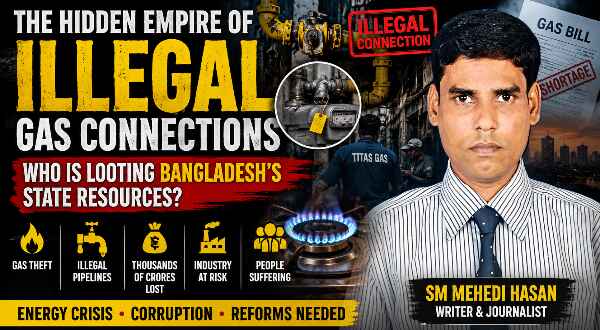

By SM Mehedi Hasan
“Gas is not merely a fuel. It is one of the principal drivers of Bangladesh’s industries, economy and everyday life. Yet this valuable national resource has remained trapped for years in a web of illegal connections, theft and corruption, causing the state losses worth billions of taka.”
Bangladesh’s energy crisis is no longer a new phenomenon. From industries and households to CNG stations and power plants, demand for natural gas far exceeds supply. Thousands of families across the country, including in Dhaka, struggle daily due to inadequate gas supply for cooking, while industries regularly report production disruptions.
At the same time, enormous volumes of gas are being stolen through illegal connections across various parts of the country.
Investigations by government agencies, independent organizations and national media have revealed an alarming picture. In Dhaka and its surrounding districts alone, nearly 100,000 consumers are reportedly using gas illegally. To facilitate this theft, approximately 300 kilometers of unauthorized pipeline networks have been installed, through which around 1.5 million cubic feet of gas are illegally consumed every day.
The Expanding Network of Illegal Gas Connections
Investigations by Titas Gas Transmission and Distribution Company Limited (TGTDCL) indicate that illegal gas connections extend far beyond the capital.
Unauthorized gas networks have been detected in Sonargaon, Araihazar and Bandar in Narayanganj; Gajaria in Munshiganj; Palash and Kanchan in Narsingdi; Kaliganj and Kaliakair in Gazipur; the BKSP area of Ashulia; and various parts of Dhaka, including Jinjira, Uttarkhan, Dakshinkhan, Demra, Nandipara, Gabtoli embankment and Savar.
In many of these areas, underground networks have been built using low-quality pipes. Stolen gas is not only being used by households but also by small industries, commercial establishments and factories.
Gas Theft Amid Severe Shortages
Bangladesh’s daily gas demand is approximately 3,800 MMCFD (million cubic feet per day), while supply stands at around 2,635 MMCFD. The country therefore faces a daily shortfall of nearly 1,200 MMCFD.
As a consequence, legitimate consumers frequently experience supply disruptions. Industries suffer production losses, and households often wait for hours simply to cook meals. Yet illegal users continue to consume stolen gas without interruption.
Energy experts argue that if gas wastage through illegal connections were eliminated, a significant portion of the gas required to operate the country’s urea fertilizer factories could be secured.
System Loss or Organized Gas Theft?
According to Petrobangla data, Titas Gas recorded an average system loss of 9.36 percent during the first eleven months of the previous fiscal year. In contrast, Jalalabad Gas Transmission and Distribution System Limited reported a system loss of only 0.65 percent.
Internationally, an acceptable level of technical system loss in gas distribution generally ranges between 0.20 percent and 0.30 percent. Against this benchmark, the loss figures reported by some Bangladeshi distribution companies are deeply concerning.
Bangladesh Energy Regulatory Commission (BERC) Chairman Jalal Ahmed has stated that although up to two percent technical loss may be considered acceptable due to Titas’ extensive network, anything beyond that cannot be justified.
Experts believe that the unusually high system loss is not merely the result of aging pipelines. Illegal connections, meter tampering and organized gas theft also play major roles.
Who Is Behind the Syndicate?
There are allegations that illegal gas connections are facilitated by a nexus involving influential local figures, politically connected individuals and certain dishonest officials and employees within gas distribution companies.
According to sources within the Ministry of Power, Energy and Mineral Resources, district and sub-district administrations have been instructed on multiple occasions to conduct drives against illegal connections. However, effective enforcement has often been lacking, allowing these networks to continue operating for years.
National newspapers have also reported allegations that, in some areas, influential local figures were involved in facilitating illegal gas connections alongside other irregular activities. Such incidents highlight how organized networks exploit institutional weaknesses and corruption to expand their illegal businesses.
Enforcement Continues, Yet Questions Remain
A report published by The Daily Star stated that during just two months in 2024, Titas disconnected 7,004 illegal gas connections, including 97 industrial connections, 56 commercial connections and 6,851 residential connections. Approximately 40 kilometers of illegal pipelines were also removed during the same period.
Furthermore, Titas reportedly disconnected more than 111,000 illegal gas connections within a year.
However, an important question remains: if such a large number of illegal connections can be removed, how are new illegal networks repeatedly being established?
A Serious Threat to Public Safety
Illegal gas connections represent not only theft of state resources but also a grave threat to public safety.
Most illegal networks rely on low-quality pipes and equipment, creating serious risks of gas leaks, fires and explosions. Bangladesh has previously witnessed several incidents involving illegal gas lines that resulted in loss of life and significant property damage.
The Haripur Lime Factory Incident
On July 2, Titas Gas authorities conducted a second operation against an illegal lime factory in Haripur, Bandar, Narayanganj. During the operation, officials disconnected the illegal gas connection and demolished the furnace used by the factory.
Local residents alleged that political influence had enabled the factory to resume operations after earlier action had been taken. However, it was shut down again by Titas shortly after reopening.
The incident demonstrates that enforcement operations alone are insufficient. Unless the influential networks behind illegal gas connections are brought under the law, permanent solutions will remain elusive.
What Needs to Be Done?
Experts recommend several urgent measures:
• Introduce comprehensive digital monitoring and smart metering systems across the gas distribution network;
• Ensure swift legal action against officials, intermediaries and influential individuals involved in illegal connections;
• Replace old and vulnerable pipelines to reduce system losses;
• Conduct regular and coordinated operations involving local administrations, law enforcement agencies and gas distribution companies.
Conclusion
Bangladesh is currently facing major challenges related to energy security, foreign currency shortages and industrial production. In this context, illegal gas connections are not merely theft of state resources. They represent a silent assault on economic development, industrialization and public safety.
Protecting national resources requires dismantling this hidden empire of illegal gas connections. Otherwise, the suffering of legitimate consumers will intensify, dependence on costly imported LNG will continue to rise and the state will bear enormous financial losses every year.
Ensuring energy security now demands political commitment, strict law enforcement and an uncompromising stance against corruption. Because stopping gas theft is not simply about protecting government revenue. It is about safeguarding Bangladesh’s economic security and strengthening the foundations of its future development.
Author:
SM Mehedi Hasan
Independent Writer and Journalist
E-mail: sm.mehedi.hasan1977@gmail.com