Why a Sylhet Province? History, Potential and the Case for Administrative Decentralization in Bangladesh

By SM Mehedi Hasan
Bangladesh has made remarkable progress over nearly 55 years of independence in economic growth, education, infrastructure, technology and human resource development. Yet one reality has become increasingly evident throughout this journey: most of the country’s major administrative, judicial, economic and policy-making activities remain heavily concentrated in Dhaka.
As a result, millions of people travel to the capital every year for education, healthcare, business, government services and legal matters. This not only consumes enormous amounts of time, money and effort but also places immense pressure on Dhaka, making the city increasingly vulnerable to congestion and overpopulation.
Against this backdrop, a renewed discussion on administrative decentralization has emerged in Bangladesh. Public administration experts argue that sustainable development, equitable distribution of resources and efficient public service delivery require a more decentralized administrative structure in the future. It is within this context that the idea of a “Sylhet Province” has entered policy discussions.
Importantly, this concept is neither a separatist demand nor an emotionally driven political campaign. Rather, it represents a policy-oriented discussion on administrative decentralization, regional economic development, improved public services and balanced national growth.
Sylhet’s Distinct Historical Background
Sylhet’s historical trajectory differs somewhat from that of other regions of Bangladesh. In 1874, under British rule, Sylhet was separated from the Bengal Presidency and incorporated into the administration of Assam. The move was primarily intended to facilitate administration and support the tea industry and revenue management.
Later, during the Partition of India in 1947, a historic referendum resulted in most of Sylhet joining East Bengal, while a portion of the Karimganj subdivision became part of India. This referendum remains a rare event in South Asian history and forms an important basis of Sylhet’s distinctive historical identity.
Following Bangladesh’s independence, Greater Sylhet was divided into four districts in 1984 as part of administrative decentralization efforts. In 1995, Sylhet officially began functioning as a separate administrative division. Some observers view this evolution as laying the groundwork for broader discussions about more effective decentralized governance structures.
Why Decentralization Matters
At present, most major policy decisions, specialized healthcare services, higher administrative functions, major investments and judicial activities are concentrated in Dhaka. Consequently, people from regions such as Sylhet often need to travel to the capital even for routine administrative matters.
This concentration has produced several challenges:
• Increasing population pressure on Dhaka;
• Higher costs and longer waiting times for public services;
• Growing regional disparities and underutilized economic potential.
International experience suggests that decentralization often improves administrative efficiency, accelerates decision-making and brings public services closer to citizens.
Why Sylhet?
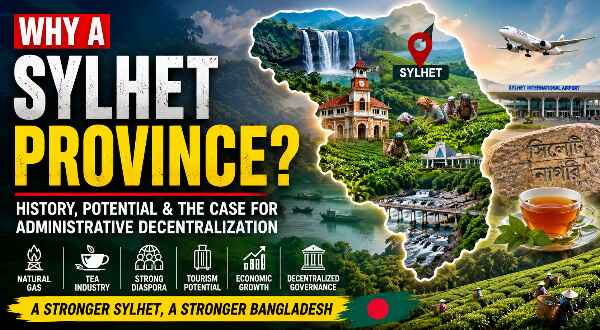
Sylhet possesses a unique combination of natural resources, international connectivity, expatriate networks and tourism assets.
The region hosts several of Bangladesh’s major natural gas fields and has played a critical role in the country’s energy security and industrial development. Its gas resources also offer significant opportunities for future gas-based industries.
Sylhet is the heart of Bangladesh’s tea industry, containing most of the country’s tea estates. The industry contributes to export earnings and supports thousands of livelihoods.
The region also benefits from a strong expatriate community, particularly in the United Kingdom, United States, Canada, the Middle East and Europe. Remittances sent by Sylhetis abroad make significant contributions to the national economy. Their savings, professional experience and investment capacity could help transform Sylhet into an important center of industrialization and employment.
Sylhet also enjoys strategic advantages through its international airport and proximity to India’s northeastern states, creating opportunities for regional trade and connectivity.
Tourism represents another major strength. Destinations such as Jaflong, Bichanakandi, Ratargul Swamp Forest, Lalakhal, Ham Ham Waterfall, Madhabkunda Waterfall, Lasubon Canyon, Tanguar Haor, Hakaluki Haor, the tea gardens of Srimangal and Lawachara National Park have made Sylhet one of Bangladesh’s most promising tourism regions.
Beyond tourism, its wetlands, forests, stone resources, minerals and agricultural potential further strengthen Sylhet’s economic significance.
A Distinct Linguistic and Cultural Identity
Sylhet’s uniqueness extends beyond economics and natural resources. The Sylheti language differs significantly from standard Bangla in pronunciation, vocabulary and grammatical structure.
Sylheti has gained recognition in various international language databases as one of the world’s widely spoken regional languages. Estimates suggest that more than 11.8 million people speak Sylheti, with some researchers and language advocates placing the figure much higher.
Sylheti also possesses its own historical script, known as Sylheti Nagri. Numerous religious, literary and folk manuscripts were written using this script. The coexistence of Bangla and Sylheti Nagri, along with a large global diaspora of Sylheti speakers, gives the region a unique linguistic and cultural identity.
Many scholars argue that this heritage deserves greater preservation and promotion as an integral component of Bangladesh’s multicultural national identity.
Economic Opportunities
If Bangladesh eventually adopts a more decentralized constitutional framework, Sylhet could attract significant investment and industrial development.
Potential growth sectors include gas-based industries, food processing, tea manufacturing, tourism, information technology, agriculture, small and medium enterprises, healthcare and higher education.
Such developments could generate substantial employment opportunities and stimulate regional economic growth.
Challenges and Considerations
The idea of a Sylhet Province also involves important constitutional and political realities. Bangladesh is constitutionally a unitary state. Any move toward a provincial structure would require constitutional amendments, political consensus, economic feasibility studies and long-term planning.
Therefore, the issue cannot be addressed through unilateral political decisions. It demands national dialogue, expert consultation and broad public participation.
Conclusion
The question of a Sylhet Province is not fundamentally about redrawing administrative boundaries. Rather, it is about exploring how administrative decentralization can improve public services, promote regional economies and achieve balanced national development.
Sylhet’s natural gas, tea industry, tourism assets, wetlands, mineral resources, agricultural potential, international connectivity, remittance economy and human capital make it one of Bangladesh’s most promising economic regions.
At the same time, administrative restructuring alone cannot guarantee development. Good governance, transparency, accountability, institutional efficiency and strategic planning remain essential.
Ultimately, the real question is not simply whether there should be a Sylhet Province. The more important question is whether Bangladesh is prepared to move toward an administrative framework in which the benefits of development extend beyond the capital and reach every region of the country more equitably. The answer to that question may well shape the next chapter of Bangladesh’s administrative and economic future.
Author:
SM Mehedi Hasan
Independent Writer and Journalist
Joint General Secretary
Jalalabad Journalists Association, Dhaka
E-mail: sm.mehedi.hasan1977@gmail.com