Global Energy Independence Day: Why Energy Security Is Vital for Bangladesh’s Sustainable Future
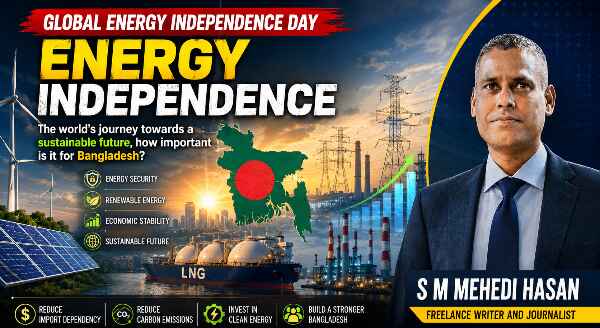

By S.M. Mehedi Hasan
As the global economy has expanded, energy has become one of the most critical drivers of development. Industry, agriculture, transportation, information technology, healthcare, and urbanization all depend on a reliable and uninterrupted energy supply. However, the COVID-19 pandemic, the Russia-Ukraine war, geopolitical tensions in the Middle East, and volatility in international energy markets have demonstrated how vulnerable countries can become when they rely heavily on imported fuel.
Sharp fluctuations in the prices of oil, natural gas, and coal have shown that energy security is no longer just an economic issue. It has become a matter of national security, financial stability, foreign exchange management, and sustainable development.
Every year on July 9, Global Energy Independence Day is observed to highlight the importance of renewable energy, energy security, carbon emission reduction, and decreasing dependence on fossil fuels. Although it is not an official United Nations observance, the day is recognized by environmental organizations, research institutions, and energy stakeholders worldwide to promote cleaner and more resilient energy systems.
Today, energy independence is not simply about protecting the environment. It is about ensuring economic resilience and securing a nation’s future.
Energy independence refers to a country’s ability to meet a significant portion of its energy demand through domestic or sustainable sources instead of relying excessively on imported fuels.
It does not necessarily mean eliminating imports entirely. Rather, it involves building a diversified energy system where domestic resources, renewable energy, energy efficiency, and advanced technologies work together to reduce external vulnerabilities.
Solar power, wind energy, hydropower, biogas, biomass, green hydrogen, and energy storage technologies are increasingly recognized as the foundations of future energy security.
Energy has always been closely linked with geopolitics. Following the global oil crisis of 1973, many countries realized that depending heavily on one or two energy sources posed significant economic risks.
The Russia-Ukraine conflict further reinforced this lesson. Several European nations relied extensively on Russian natural gas, and disruptions in supply forced them to accelerate investments in renewable energy, diversify energy imports, and strengthen energy conservation programs.
Similarly, spikes in crude oil prices increase transportation costs, electricity generation expenses, industrial production costs, and inflation across economies.
As a result, both developed and developing countries are now prioritizing energy diversification and renewable energy expansion as central components of national policy.
Different countries have pursued energy independence according to their own geographical and economic circumstances.
China has become one of the world’s largest producers of solar and wind energy while investing heavily in battery manufacturing and electric vehicles.
Germany continues implementing its long-term Energiewende (Energy Transition) strategy to replace fossil fuels with renewable sources.
Denmark has gained international recognition for generating a substantial share of its electricity from wind power.
India has emerged as a global leader in solar energy and remains one of the principal founders of the International Solar Alliance.
Even the United Arab Emirates, historically dependent on oil exports, has invested billions of dollars in some of the world’s largest solar energy projects.
These examples demonstrate that energy independence is not based on a single technology. Instead, it requires long-term planning, policy consistency, innovation, and investment.
Over the past decade, Bangladesh has made remarkable progress in expanding electricity access. Nearly the entire population now has access to electricity, supporting rapid industrialization, urban development, and digital transformation.
However, this achievement has also revealed a significant vulnerability.
Domestic natural gas production has gradually declined, increasing dependence on imported liquefied natural gas (LNG), coal, and petroleum fuels. Whenever international fuel prices rise, electricity generation costs increase, affecting industries, transportation, inflation, and overall economic performance.
Economists note that rising fuel imports not only place pressure on government finances but also strain foreign exchange reserves and reduce export competitiveness by increasing production costs.
Therefore, energy security has become a fundamental component of Bangladesh’s long-term economic strategy.
Bangladesh spends billions of dollars annually on importing fuel. When global oil, LNG, or coal prices increase, the country’s import bill rises accordingly.
Higher electricity generation costs lead to increased manufacturing expenses, transportation costs, and consumer prices, creating a chain reaction throughout the economy.
For this reason, many countries now view energy not merely as a commodity but as a strategic pillar of economic security.
Bangladesh possesses significant renewable energy potential, particularly in solar power.
The country receives abundant sunlight for most of the year, creating opportunities for rooftop solar systems, industrial solar installations, and solar-powered irrigation in agriculture.
Coastal regions also have potential for wind energy, while livestock waste and agricultural residues could support biogas and biomass-based electricity generation.
Realizing these opportunities will require long-term investment, supportive government policies, private sector participation, and technological innovation.
Despite its promise, renewable energy development faces considerable obstacles.
Bangladesh’s high population density limits the availability of land for large-scale solar farms. Solar and wind energy are also weather-dependent, making energy storage systems and modern power grids essential.
Furthermore, expanding renewable energy will require investment in technology transfer, skilled human resources, financing mechanisms, and research.
Experts argue that Bangladesh’s most practical approach is gradual diversification by improving domestic gas utilization, expanding renewable energy, promoting energy efficiency, and modernizing the national electricity grid.
Increasing electricity generation alone will not ensure energy independence.
Around the world, energy efficiency is increasingly described as the “First Fuel” because reducing energy waste often delivers greater economic benefits than constructing new power plants.
Bangladesh can significantly improve energy security by promoting energy-efficient appliances, modernizing electricity transmission and distribution networks, deploying smart grid technologies, and enhancing industrial energy management.
Future energy security will depend equally on efficient management, technological innovation, and responsible energy consumption.
Energy independence is closely connected to climate change.
Burning coal, oil, and natural gas remains one of the largest sources of global carbon dioxide emissions, contributing to global warming, rising sea levels, extreme weather, and natural disasters.
Although Bangladesh contributes only a small share of global greenhouse gas emissions, it remains among the world’s most climate-vulnerable nations. Cyclones, flooding, river erosion, salinity intrusion, and irregular rainfall already threaten agriculture, fisheries, infrastructure, and livelihoods.
For Bangladesh, renewable energy is therefore not only an alternative energy source but also a vital strategy for climate resilience and sustainable development.
The Government of Bangladesh has introduced several initiatives to diversify energy sources, improve electricity infrastructure, and expand renewable energy.
However, experts emphasize that effective implementation is just as important as policy formulation.
Encouraging private investment, simplifying regulatory approvals, strengthening transmission infrastructure, and increasing funding for research and technological development will be essential.
Greater collaboration among universities, research institutions, industries, and policymakers can also help develop local expertise and homegrown energy technologies.
Energy independence is ultimately about combining infrastructure, innovation, sound policy, and skilled human resources.
Energy security is not solely the government’s responsibility.
Individuals can contribute by reducing unnecessary electricity consumption, using energy-efficient appliances, improving natural ventilation and lighting in buildings, and installing rooftop solar systems where feasible.
Businesses and industries can adopt modern energy management practices to lower operating costs while reducing environmental impacts.
Collective action at every level can significantly reduce national energy demand.
The global economy is rapidly transitioning toward clean energy.
Electric vehicles, battery storage, smart grids, green hydrogen, artificial intelligence, and advanced energy management systems are reshaping the future of the energy sector.
Countries investing today in renewable energy, innovation, and energy efficiency will gain significant competitive advantages in tomorrow’s economy. Those that remain dependent on imported fossil fuels may face increasing financial and strategic risks.
For Bangladesh, maintaining economic growth will require equal emphasis on energy security, energy diversification, and efficient energy management.
Global Energy Independence Day serves as an important reminder that energy independence is not a luxury. It is an essential foundation for sustainable development.
The more diversified, efficient, and environmentally responsible a country’s energy system becomes, the stronger and more resilient its economy will be.
Bangladesh has already achieved remarkable progress in expanding electricity access. The next challenge is ensuring that this progress is sustainable through greater use of domestic resources, renewable energy expansion, energy-efficient technologies, smart grid development, and increased investment in research and innovation.
Energy independence is not simply about producing more electricity. It is about building a resilient system capable of protecting industries, agriculture, businesses, and households from global energy shocks.
Achieving that vision will require coordinated efforts from government, the private sector, research institutions, and citizens alike.
Author:
S.M. Mehedi Hasan
Independent Writer and Journalist
E-mail: sm_mehedi.hasan1977@gmail.com