Cooperatives and Economic Liberation: A New Horizon of Shared Prosperity
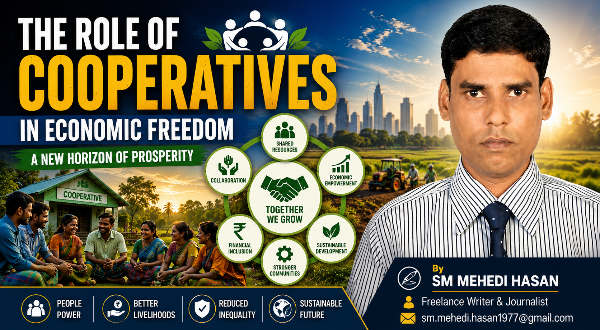

By S M Mehedi Hasan
“At a time when income inequality and employment challenges are steadily increasing in Bangladesh, can cooperatives based on collective capital and shared initiatives become an effective alternative for economic liberation?”
“United we stand, divided we fall.” This timeless principle lies at the heart of the cooperative movement. By rising above individual interests and embracing collective initiatives, mutual support, and shared ownership, cooperatives create pathways toward economic empowerment and social progress.
One of the most effective and time-tested approaches to building an equitable, self-reliant, and inclusive society is the cooperative model. In the history of global economics, cooperatives have emerged as a humane and sustainable alternative beyond the monopolistic tendencies of capitalism and the rigid structures of socialism. Rather than relying on concentrated capital, cooperatives transform small savings, collective labor, and mutual trust into a formidable economic force.
Every year, the first Saturday of July is observed worldwide as the International Day of Cooperatives. Jointly celebrated by the United Nations and the International Cooperative Alliance (ICA), the day highlights the contribution of cooperatives to poverty reduction, employment generation, social inclusion, and sustainable economic development. For an emerging economy like Bangladesh, the importance of cooperatives in achieving the Sustainable Development Goals (SDGs), reducing income inequality, and empowering marginalized communities deserves renewed attention and recognition.
The core philosophy of cooperatives can be summed up in the principle: “All for one and one for all.” A cooperative is a voluntary and autonomous association where people with similar interests or professions work together through shared ownership to achieve economic, social, and cultural well-being.
The modern cooperative movement began in 1844 in Rochdale, Lancashire, England. Amid the economic hardships that followed the Industrial Revolution, twenty-eight textile workers established a grocery store based on cooperative principles to improve their livelihoods. Known as the Rochdale Society of Equitable Pioneers, their principles of democratic control, equality, honesty, and member welfare remain the foundation of the global cooperative movement today.
In the Indian subcontinent, the institutional journey of cooperatives formally began with the enactment of the Cooperative Credit Societies Act of 1904. In independent Bangladesh, the Father of the Nation, Bangabandhu Sheikh Mujibur Rahman, regarded cooperatives as one of the key pillars of the national economy. Article 13(b) of the Constitution of Bangladesh recognizes cooperative ownership as a state-supported economic principle. Later, Dr. Akhtar Hameed Khan’s Comilla Model opened a new chapter in cooperative-based rural development in Bangladesh.
Bangladesh’s economy remains heavily dependent on agriculture. However, most farmers are small and marginal producers who struggle with inadequate capital, limited access to modern technologies, and exploitation by middlemen.
Through cooperatives, farmers can collectively access tractors, power tillers, irrigation facilities, and modern agricultural technologies. Joint marketing systems also enable them to sell their produce directly and secure fair prices.
One of Bangladesh’s most successful cooperative initiatives is Milk Vita, the country’s leading dairy cooperative. By bringing thousands of small dairy farmers under a cooperative framework, Milk Vita has not only facilitated milk collection and marketing but has also created employment opportunities, ensured fair prices for producers, and increased household incomes in rural communities. It stands as a shining example of how the collective strength of small producers can evolve into a nationally recognized brand.
The Bangladesh Academy for Rural Development (BARD) model in Comilla represents another historic milestone in cooperative-based rural development. Established under the leadership of Dr. Akhtar Hameed Khan during the 1960s, the model introduced a two-tier cooperative system, improved irrigation management, expanded agricultural credit, promoted infrastructure development, and fostered local leadership. The Comilla Model later became an inspiration for rural development programs in various countries across Asia and Africa.
Among the world’s most successful cooperative ventures is Amul, India’s dairy cooperative giant. By organizing millions of small dairy farmers into an extensive cooperative network, Amul spearheaded India’s “White Revolution” and became one of the world’s largest dairy cooperatives. It demonstrates how the collective power of small producers can transform an entire national economy.
The combined annual turnover of the world’s top 300 cooperatives amounts to several trillion US dollars. This clearly illustrates that cooperatives are not charitable enterprises but robust, sustainable, and partnership-based economic institutions capable of reducing inequality and fostering inclusive development.
Cooperatives play a vital role in handloom production, pottery, handicrafts, fisheries, and small enterprise development. By converting small savings into productive capital, cooperative societies support their members in procuring raw materials, increasing production, and improving market access.
Handloom cooperatives in Pabna, Sirajganj, and Tangail have organized thousands of weavers and helped sustain Bangladesh’s traditional textile industry. Similarly, fishermen’s cooperatives in Cox’s Bazar, Khulna, Barishal, and Bhola facilitate savings mobilization, provide easier access to credit, enable the acquisition of modern equipment, and ensure fair prices for fish products. These cooperatives not only promote economic activities but also contribute significantly to social empowerment and improved living standards among marginalized communities.
Cooperatives have also proven particularly effective in integrating rural women into economic activities, thereby strengthening women’s economic empowerment and improving family well-being.
The cooperative system is not designed to maximize the profit of a single owner; rather, it is a people-centered economic model focused on generating employment and ensuring equitable distribution of resources.
According to the International Cooperative Alliance, approximately 280 million people worldwide are directly or indirectly associated with cooperatives, accounting for nearly 10 percent of global employment. In Bangladesh, savings-based cooperative initiatives are enabling thousands of unemployed youth and women to become entrepreneurs and play a meaningful role in poverty reduction.
Many rural and marginalized communities remain excluded from formal financial services due to the stringent requirements of commercial banks. Savings and credit cooperatives address this challenge by providing loans on flexible terms, allowing members to participate in productive economic activities.
As a result, many people can avoid dependence on moneylenders and high-interest informal borrowing systems. Numerous savings and credit cooperatives across Bangladesh have provided low-income families with the capital needed to establish small businesses, engage in farming, and pursue self-employment opportunities.
Bangladesh currently has more than 100,000 registered cooperative societies, with millions of people directly or indirectly involved in cooperative activities. Cooperatives are making significant contributions in agriculture, fisheries, dairy production, savings and credit, housing, and small enterprise development.
Despite its enormous potential, however, the sector has yet to achieve its desired level of success. One of the major challenges is the lack of professionalism and managerial capacity. Many cooperatives still struggle with modern management practices, accounting systems, and the use of information technology.
Additionally, instances of corruption, fund misappropriation, irregularities, political interference, and weak oversight have undermined public confidence in some cooperative societies. In certain cases, cooperatives have been misused to serve personal interests, thereby damaging the reputation of the entire movement. Weak governance, irregular audits, and poor loan recovery mechanisms have also hindered the long-term sustainability of many cooperative organizations.
To make cooperatives relevant in the era of the Fourth Industrial Revolution, technology-driven and transparent management systems must be established. Financial records, membership databases, and dividend distribution systems should be fully digitized. Integrating cooperatives with mobile banking and digital payment systems can significantly enhance transparency and accountability.
Greater efforts are also needed to engage young people in cooperative activities through training, entrepreneurship development, and technology-based business skills. At the same time, the supervisory mechanisms of the Department of Cooperatives must be strengthened, and regular audits should be conducted to ensure the safety and security of members’ savings.
Economic liberation does not simply mean creating wealth for a privileged few; it means ensuring a dignified life, equal opportunities, and financial security for every member of society. At a time when capitalist economies continue to experience widening gaps between rich and poor, cooperatives offer a practical model based on equality, partnership, and inclusive development.
What may seem impossible through individual effort often becomes achievable through collective action. This is the fundamental strength of cooperatives. By reducing economic disparities and fostering participation, cooperatives can build the foundation for sustainable and inclusive development.
Cooperatives should therefore be viewed not merely as social welfare initiatives but as the third pillar of the national economy. With digital governance, professional management, and strong accountability mechanisms, cooperatives can emerge as one of the most powerful drivers of an inclusive and equitable economy.
Author:
S M Mehedi Hasan
Freelance Writer and Journalist
Joint General Secretary, Jalalabad Journalists Association, Dhaka
Email: sm.mehedi.hasan1977@gmail.com