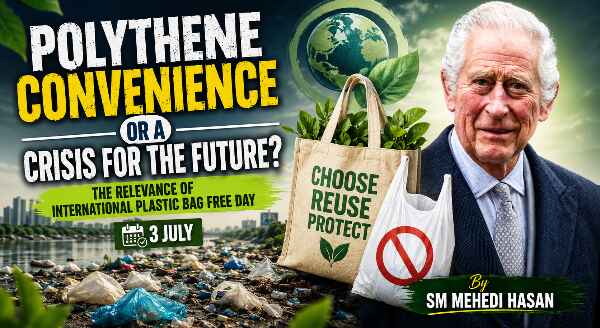
Polythene Convenience or a Crisis for the Future? The Relevance of International Plastic Bag Free Day

By SM Mehedi Hasan
We use a plastic bag for only a few minutes, yet it may take between 500 and 1,000 years to decompose. For the sake of a few moments of convenience, we are leaving behind centuries of pollution for future generations.
Whether for grocery shopping, carrying goods, or packaging food, plastic bags have become an inseparable part of our daily lives. Their lightweight nature, low cost, and easy availability have contributed to their rapid global spread. However, the same plastic that has made our lives easier has also become one of the world’s most pressing environmental challenges.
The effects of plastic pollution have spread from rivers, oceans, forests, and agricultural lands to the human food chain itself. Recent studies have even detected microplastics in human blood, lungs, and placentas. Plastic pollution is no longer just an environmental issue; it is increasingly becoming a serious threat to human health.
Against this backdrop, the world observes International Plastic Bag Free Day every year on 3 July. The day aims to raise awareness about the harmful impacts of single-use plastic bags and encourage the adoption of environmentally friendly alternatives.
International Plastic Bag Free Day originated through the collective efforts of environmental organisations. International networks, including the European environmental alliances GAIA (Global Alliance for Incinerator Alternatives) and Zero Waste Europe, initiated campaigns against single-use plastics to create global awareness. Over time, environmental groups and civic initiatives across Europe, Asia, Africa, and Latin America expanded the movement worldwide.
Today, the day is observed in more than 100 countries through various awareness campaigns and activities. It is not merely a symbolic observance but a call for coordinated action by individuals, communities, businesses, and policymakers to protect the environment.
According to the United Nations Environment Programme (UNEP), more than 400 million tonnes of plastic are produced globally each year, a significant portion of which is discarded after a single use. Around 11 million tonnes of plastic waste enter rivers and oceans annually.
Several international studies and forecasts warn that if current trends continue, by 2050 the amount of plastic in the oceans could equal or even exceed the total weight of fish.
The greatest challenge of plastic waste is its durability. Most plastics remain in the environment for hundreds of years. Although sunlight and natural processes break them down into tiny particles, they never completely disappear. Instead, they become microplastics that infiltrate soil, water, and the food chain.
Bangladesh’s plastic industry has grown into a domestic market worth nearly US$3 billion. According to the Bangladesh Investment Development Authority (BIDA), the country has more than 5,000 plastic manufacturing units, both formal and informal, around 98 percent of which are small and medium enterprises.
The sector generates employment for approximately 1.2 to 1.5 million people, while Bangladeshi plastic products are exported to more than 126 countries. Major companies, including RFL, have significantly contributed to enhancing Bangladesh’s manufacturing capacity through the export of plastic and household products.
Therefore, addressing plastic pollution is not merely an environmental issue. It is equally linked to the economy, employment, industrialisation, and sustainable development.
Bangladesh is among the countries most vulnerable to plastic pollution.
During the devastating floods of 1998, massive amounts of polythene bags clogged drains and sewage systems in Dhaka, worsening urban flooding. Based on that experience, Bangladesh became the first country in the world to ban thin polythene bags.
However, despite the ban, the reality remains different. Enormous quantities of plastic bags are still used daily across the country. Due to inadequate waste management, weak enforcement, and insufficient public awareness, these plastics accumulate in rivers, canals, drainage systems, and agricultural land, causing long-term environmental damage.
Plastic waste is also considered one of the major causes of urban waterlogging during the monsoon season, while its impact on riverine and marine ecosystems is becoming increasingly alarming.
Scientists now regard microplastics as a silent global crisis.
Recent studies have found microplastics in human blood, lungs, and even in the placentas of pregnant women. Researchers fear that these tiny plastic particles may have long-term effects on hormonal balance, immune function, and reproductive health.
Plastic is no longer only a problem of rivers, oceans, and land. It is gradually becoming a permanent presence inside the human body.
Experts believe that legislation alone is insufficient to tackle plastic pollution. Meaningful progress requires behavioural change, easy access to sustainable alternatives, and effective waste management systems.
For Bangladesh, this is not an unfamiliar challenge. As the land of jute, the country has a rich tradition of using environmentally friendly alternatives. Greater emphasis on cloth bags, jute bags, paper packaging, and reusable materials could significantly reduce plastic consumption.
Refusing to accept a plastic bag may seem like a small action. Yet, millions of such individual choices can collectively create profound social and environmental change.
Plastic bags have provided temporary convenience, but they are gradually taking away the natural flow of rivers, soil fertility, marine biodiversity, and even human health.
Bangladesh once set a global example by taking the bold step of banning polythene bags. The country can once again lead by promoting jute and other eco-friendly alternatives.
On this International Plastic Bag Free Day, let us commit ourselves to ensuring that our planet is not trapped by single-use plastics any longer. Choosing a cloth or jute bag may appear to be a small decision, but it could become one of the most significant steps towards building a livable world for future generations.
Author: SM Mehedi Hasan
Freelance Writer and Journalist