Birth Registration: The First Step to Legal Identity in Bangladesh
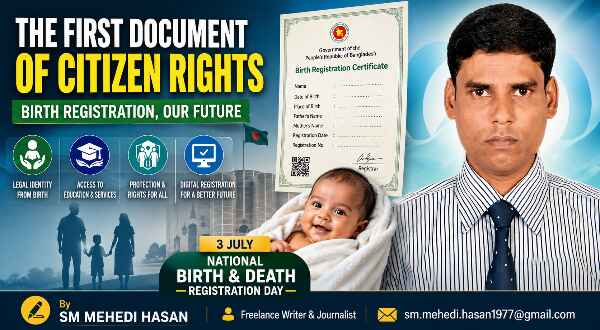

By S. M. Mehedi Hasan
“The birth of a child marks the arrival of a new life, while birth registration grants that life official recognition as a citizen of the state.”
A child is not only born into a family but also becomes a new citizen of a country. But how does the state know that a new citizen has entered its territory? How can that child later prove his or her legal nationality? The answer lies in one essential document: the birth certificate.
Birth registration is far more than a piece of paper. It is the first official record of a person’s legal identity. It serves as the foundation for accessing education, healthcare, passports, national identity cards, inheritance rights, social protection programs, and numerous government services. From birth to death, it forms the first link in an individual’s legal and administrative identity.
Every year on July 3, Bangladesh observes National Birth and Death Registration Day. The day aims to raise public awareness about the importance of registering every birth and death, ensuring legal identity for all citizens, and building a reliable national population database.
Although birth and death registration has existed in Bangladesh for many years, it became institutionalized through the Births and Deaths Registration Act, 2004, which came into effect on July 3, 2006. Since then, the government has gradually digitized the registration process.
Today, registration is managed through the Birth and Death Registration Information System (BRIS), making it easier to register events, verify records, and obtain certificates online.
Many parents believe birth registration becomes necessary only when a child starts school. In reality, it is essential throughout a person’s life.
Most public and private educational institutions in Bangladesh require a birth certificate for admission. It verifies both a child’s identity and age.
Birth registration serves as the primary document for obtaining a National Identity (NID) card and a passport. Errors in birth records can create significant complications later in life.
Child marriage remains a social challenge in Bangladesh. Digital birth registration enables authorities to verify a child’s age accurately, making it an effective legal tool for preventing underage marriages.
Birth certificates are also required for inheritance documentation, voter registration, passports, licenses, social safety net programs, and numerous other government services.
Under Bangladesh’s registration law, parents are encouraged to register a child’s birth as soon as possible. Completing registration within the prescribed period simplifies the process and reduces the need for additional documentation.
However, many families still delay registration due to lack of awareness or negligence. As a result, they often face lengthy administrative procedures and unnecessary complications years later.
Another common problem is inaccurate information. Mistakes in names, dates of birth, or parents’ details may seem minor initially but can create major difficulties in education, passport applications, overseas travel, and other official matters. Careful verification during registration is therefore essential.
Bangladesh’s birth registration system has become increasingly digital. Applications can now be submitted online through Union Parishads, municipalities, city corporations, and Union Digital Centers.
Despite these improvements, several challenges remain.
Technical problems, including server downtime, often delay services. In some cases, dishonest intermediaries exploit citizens by charging unauthorized fees.
Greater integration between hospitals, healthcare facilities, and the BRIS platform could further improve efficiency. If birth information were automatically transmitted to the registration system immediately after delivery, the process would become faster, more accurate, and far more convenient for parents.
Birth registration protects individual rights while also strengthening national development planning.
Reliable birth and death records provide essential demographic data for education planning, healthcare expansion, vaccination campaigns, child mortality monitoring, and social protection programs.
Without accurate civil registration data, governments cannot effectively design or implement long-term development policies.
Although birth registration services are now largely digital, public complaints about administrative difficulties continue.
Reports published in national and local media have documented allegations that some registration offices have collected fees beyond the officially approved rates. Many citizens, unfamiliar with the legal procedures, become victims of brokers or corrupt middlemen.
Even more concerning, media investigations in recent years have reported allegations that, in some cases, computer operators working in collusion with Union Parishad chairpersons issued fraudulent birth registrations to ineligible individuals, including Rohingya refugees. Legal action was taken in several cases, and the Ministry of Local Government imposed administrative measures against those found responsible.
Such incidents undermine not only the integrity of birth registration but also national security, the credibility of the country’s civil registration database, and public confidence in government institutions. Since birth registration now forms the basis for obtaining national identity cards, passports, and many other public services, maintaining the system’s integrity is of critical importance.
Ensuring complete transparency, accountability, and technology-based monitoring should therefore remain a national priority. Public awareness about official fees and procedures, stronger online verification systems, regular training for registration officials, and swift action against corruption can significantly enhance public trust in the system.
Birth registration is a child’s first legal identity, first official recognition, and the cornerstone of a secure future. It is not merely an administrative procedure but the gateway to citizenship, legal rights, social justice, and public services.
The true significance of National Birth and Death Registration Day will be realized only when every birth and every death in Bangladesh is registered promptly and accurately. By raising awareness and ensuring timely registration, we can help every child begin life with the legal identity and dignity they deserve.
Author: S. M. Mehedi Hasan
Freelance Writer and Journalist
E-mail: sm.mehedi.hasan1977@gmail.com